



| Quick Answer In most cases, no. For existing pavers being re-sanded, wait a minimum of 24 to 48 hours after sanding is complete and joints are fully dry, not just the surface. For brand-new paver installations, wait 30 to 90 days. Fort Myers humidity and afternoon storms make both timelines less forgiving than national guides suggest. |
We get this question on almost every job we book in Fort Myers, Cape Coral, and Naples. A homeowner gets their pavers sanded, the surface looks dry by afternoon, and they want to seal that same day or the next morning.
We understand the impulse. But sealing too soon is one of the most expensive mistakes you can make with pavers, and it’s one of the most common calls we get after another company has already been out.
The Short Answer for Fort Myers Homeowners
For existing pavers being cleaned and re-sanded: wait a minimum of 24 to 48 hours. That’s under ideal conditions with low humidity, no rain in the forecast, and sprinklers off. Brand-new paver installations need 30 to 90 days before sealing pavers.
What makes Fort Myers different is the humidity. Morning humidity in Southwest Florida averages around 88 percent. Your pavers can feel completely dry on top while the joints underneath are still saturated. A 24-hour national guideline was not written for this climate.
If it rained after sanding, restart the clock entirely. There is no shortcut past that.
When You Can vs. Can’t Seal After Sanding
| Your Situation | Verdict | Why |
| New paver installation, under 90 days | Not yet | Efflorescence needs to work through the surface first. Sealing locks it in permanently. |
| Existing pavers, just sanded today | Wait | Sand joints need 24 to 48 hours to dry all the way through, not just the surface. |
| Existing pavers sanded yesterday, no rain, low humidity | Maybe | Check joint moisture below the surface before proceeding. Surface appearance is not enough. |
| Rained after sanding, before sealing | Not yet | Restart the drying clock. Joints hold moisture long after the surface looks dry. |
| Polymeric sand installed today | Not yet | Polymeric sand requires 24 to 48 hours to cure and set before any sealer is applied. |
| Pool deck area, sanded and dry | Add buffer | Splash zones and coping retain overnight moisture. Give it an extra 12 to 24 hours. |
| Professionally prepped with hydro-compaction | Follow your contractor | Wet-sand method means joints are intentionally saturated during prep. Only the technician knows when they are ready. |
| Morning dew or irrigation overspray on surface | Not yet | Morning dew or irrigation overspray on the surface |
Why You Shouldn’t Rush Sealing After Sanding
What’s Actually Happening in Your Paver Joints
Paver stability comes from the sand in the joints. The interlocking joint system holds everything in place, and it only works if the sand is properly settled and completely dry before a sealer is applied.
We use a process called hydro-compaction when we sand. We push water into the sand so it fills the joints all the way down to the bottom. The sand needs to sit about 1/8 to 1/4 inch below the top edge of the paver. That method gives you a far more stable joint than dry-sweeping sand in.
The catch: those joints are intentionally wet when we finish. That moisture has to fully escape before sealing. There is no way around it.
We also use SEC joint sand on every job. It’s ASTM C144 graded, angular, and washed. That angular shape provides structural integrity to the joint. Play sand or mason sand from a hardware store packs differently and breaks down faster under a sealed surface. The sand matters as much as the sealer does.
Why “Looks Dry” Is Misleading and What Goes Wrong When You Seal Too Soon
The surface of your pavers can dry in a few hours on a sunny Fort Myers afternoon. The sand in those joints can stay wet for another day or more. When morning humidity is near 88 percent, the gap between surface drying and joint drying widens.
| “Dry to the eye doesn’t mean dry where it matters. It means dry in the joints.” — Fernando Vargas, Vargas Paver Sealing |
Sealing over wet or unstabilized joints causes a chain reaction that most homeowners don’t see coming until they’re looking at a failed job.
| What Goes Wrong | Why It Happens | What You’re Left With |
| White haze or blistering | Moisture trapped under a non-breathable sealer | Full strip and reseal required |
| Bubbling or peeling | Sealer can’t bond to a damp or dusty surface | Premature failure across the whole surface |
| Sand shifting after sealing | Unstabilized joints move under sealer load | Joint gaps reappear, surface becomes uneven |
| Patchy or uneven finish | Moisture variation affects adhesion across the surface | Inconsistent appearance, visible problem areas |
The failure we see most often is a white film or cloudiness that doesn’t go away when the surface gets wet. That’s trapped moisture under a failed sealer. At that point, you’re not touching it up. You’re stripping the entire surface and starting over.
Fort Myers Weather Changes Everything
Fort Myers receives over 57 inches of rain per year, concentrated in a four-month wet season. We’re talking about roughly nine to ten inches per month from June through September. That’s not a footnote. It’s why ‘wait 24 hours’ doesn’t mean the same thing here as it does in most of the country.
The combination of heat, humidity, and afternoon pop-up storms makes every timing decision here more consequential than the national guides suggest.
| Fort Myers Factor | When | Impact on Drying and Sealing | Our Recommendation |
| Wet season rainfall | June through September | 9 to 10+ inches per month resets drying windows and washes out fresh sand | Seal in the morning only; confirm no afternoon rain in the forecast before starting |
| High morning humidity, averaging near 88% | Year-round | Surfaces dry faster than joints. Surface appearance is unreliable. | Add 12 to 24 hours to the minimum wait after any wash or sanding work |
| Average highs over 91 degrees June through August | Summer months | Intense heat dries the surface quickly, masking how wet the joints still are | Never judge readiness by surface appearance alone during summer months |
| Hurricane season | June 1 through November 30, peak August through October | Wind-driven rain, debris, and unpredictable scheduling windows | Best sealing windows are before June or after October |
| Salt air and coastal exposure | Year-round near the Gulf and coastal areas | Accelerates joint erosion and mold regrowth between maintenance visits | Shorten your reseal interval. Don’t wait for the three-year mark near the coast. |
| Morning dew and irrigation overspray | Year-round | Can re-wet recently sanded joints overnight even on dry days | Can re-wet recently sanded joints overnight, even on dry days |
How Vargas Paver Sealing Prepares Pavers Before Sealing
Timing depends on more than the clock. It depends on whether every prep step was done correctly first. A paver that went through the full process is in a completely different state than one that got a pressure wash and a dry sweep.
Here is exactly what we do on every job before a single drop of sealer gets applied.
The Full 8-Step Process

1. Inspection and assessment. We assess the current condition of the pavers, joints, and sand before anything begins. This determines what the job actually needs.
2. Sanitization. We apply a mixture of pool chlorine (sodium hypochlorite) and water to the entire surface. This kills all bacteria, mold, and algae and loosens buildup before we pressure-wash. It’s safe for your plants and landscaping.
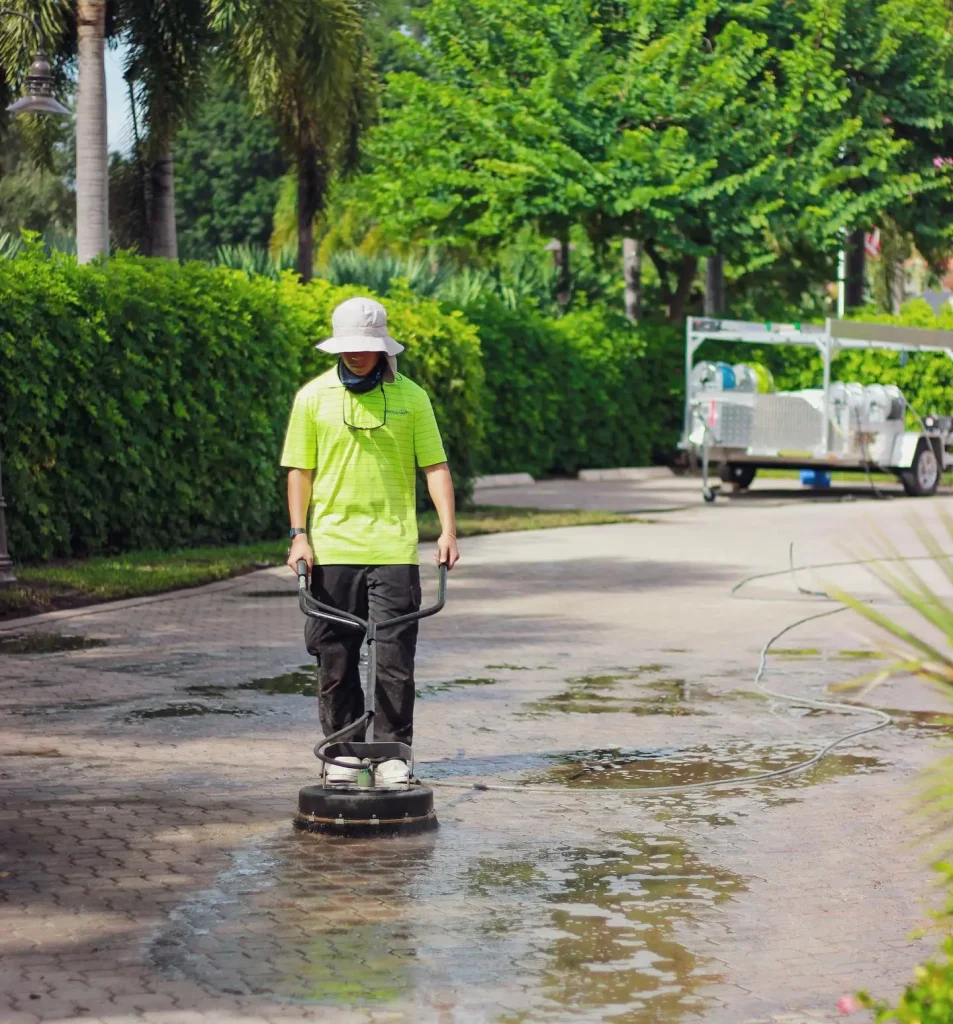
3. Pressure washing. We clean every surface using a rotary surface cleaner and a turbo nozzle for the joints. We clear out roughly one inch of old sand and debris from the joints so the new sand starts fresh.
4. Specialty stain removal. Rust gets treated with Cobble Oxide. Efflorescence and salt deposits get Cobble Prep. Oil, grease, and hydraulic fluid get their own treatment. Every stain is addressed before we move to the next step.
5. Sodium hydroxide degreasing. This step is part of every job we do, and most companies skip it entirely. The lye pulls embedded dirt out of the pavers, the contaminants that pressure washing cannot reach. If a company skips this step, they are sealing over a surface that is not actually clean. That is why the sealer fails.
6. Sanding and hydro-compaction. We sweep in the sand and then push water through it to fill the joints all the way to the bottom. The sand needs to sit 1/8 to 1/4 inch below the paver edge. The joints are wet when we finish. This is the phase that makes timing non-negotiable.
7. Sealing. We select the right sealer based on the surface, material, and customer preference. Topical sealers typically get two coats. Penetrating sealers get one coat, and the excess gets mopped off. A more penetrating sealer is not better. It’s the opposite.
8. Quality assurance and site security. We tape off driveways so no one drives on them, close access to pool decks, and do a full inspection before we consider the job done.
The specification states that joint sand must be fully settled and stable before sealing. That’s the industry standard, and it’s what our process is built around.
Why Process Completion Determines Timing, Not Just the Clock
The drying clock starts when the last prep step is done correctly. Not when the job begins.
A paver that was sanitized, degreased, and hydro-compacted properly is ready for sealing on a different timeline than one that got skipped steps. The sealer responds to what’s actually on the surface. If embedded dirt remains, the sealer bonds to it. When the dirt eventually releases, so does the sealer.
Correct preparation is not an upsell. It’s the reason the sealer lasts.
How to Know If Your Pavers Are Ready to Seal
Use this before sealing begins. All boxes need to be checked.
- Surface is visually dry with no sheen and no color variation from moisture
- Joints are dry below the surface (press a finger or the tip of a screwdriver 1/4 inch into the joint; no moisture or coolness should be present)
- Sand is compacted, stable, and sitting 1/8 to 1/4 inch below the paver edge
- No visible staining, efflorescence, or residue remaining on the surface
- No rain in the forecast for the next 24 hours (48 hours is the better target in summer)
- The sprinkler system has been off for at least 24 to 48 hours
- For pool decks: pool is off, and the coping area has been checked for moisture
- For new installations: minimum 30 days have passed (60 to 90 days is the better target in Southwest Florida)
The joint poke test is the one step almost everyone skips. Surface appearance in this climate is not reliable. The only way to confirm the joints are ready is to check below the surface.
Does It Change for Pool Decks, Driveways, or Lanais?
| Surface | Wait Time (Existing Pavers) | Fort Myers Adjustment | Notes |
| Driveway | 24 to 48 hours | Add 12 hours in humid conditions | No driving for 48 hours after sealing is complete |
| Pool deck | 24 to 48 hours plus buffer | Add 24 hours for splash zones and overnight moisture | Coping is rolled on, not sprayed. We roll it to prevent sealer from entering the pool. |
| Lanai or covered patio | 24 to 36 hours | Standard. Shaded areas dry a bit faster. | Check for mold buildup in shaded joints before sealing |
| Walkways | 24 to 48 hours | Standard | No foot traffic for 3 to 6 hours after sealing |
| Natural stone or travertine | 24 to 48 hours | Standard | Requires a penetrating sealer, not a topical coating. Different application method. |
| New installation, any surface | 30 to 90 days | 60 to 90 days preferred in Southwest Florida | Do not seal before efflorescence has worked through the surface |
Pool coping is the one part of any pool deck job that gets handled differently. We roll the sealer onto the coping rather than spray it to prevent the sealer from dripping into the water. Everything else on a pool deck is sprayed. That’s the only application difference for that surface.
How Long Does Sealer Last in Fort Myers?
The total lifespan of a paver sealer is three to five years. That’s from the day of application to completely gone. Most of the content you’ll find online stops there, which creates real confusion about when to reseal.
| “If you search it up on Google, it’ll just say three to five years. But they don’t elaborate that that means from brand new to completely gone, and at that point you have to redo the whole thing.” — Fernando Vargas |
We recommend resealing every two to three years. Not when the sealer fails. Before it gets there.
Waiting until the sealer is gone means starting from scratch: full sanitization, degreasing, re-sanding, and resealing. Resealing while the surface still has protection means faster prep, better adhesion, and a longer-lasting result.
In Fort Myers, don’t push toward the three-year end of that range. Pool decks and south-facing driveways with year-round UV exposure need to be on a tighter schedule. Coastal properties near the Gulf face more moisture and salt exposure, which adds wear between maintenance cycles.
Topical sealers show wear more visibly over time, which makes it easier to judge. Penetrating sealers protect from within and don’t show surface wear the same way, so regular inspections are more important for those.
Maintenance Matters More Than Timing Alone
| “Just because you seal them doesn’t mean you stop maintaining them.” — Fernando Vargas |
Sealed pavers are low maintenance. They require no maintenance. Unsealed pavers are like sponges. Water, mold, algae, and staining go straight into the material. Sealed pavers are more like your floor inside the house. You still clean them, but you’re mopping instead of scrubbing.
What consistent maintenance looks like in Fort Myers:
- Clean every 6 to 12 months, depending on sun exposure, shade, and foot traffic
- Sweep or blow off debris regularly. Leaves and grass sitting in the joints accelerate mold and weed growth.
- Keep plants off the paver surface. Planters placed directly on pavers hold moisture and introduce weeds.
- Inspect joints after heavy storms, especially June through September
Sealing slows down weed and algae growth. It does not stop it. Maintenance is what actually keeps problems from coming back.
Our paver maintenance loyalty program is built around this. You get up to three cleaning visits per year, sand top-ups, spot sealing, and coverage for your next full reseal when the time comes. All for a fixed annual rate. You call when you need it, and we handle the rest. Ask about current pricing and availability when you call us at 239-312-3180.
| Fort Myers HOA and Permit Note If you live in a gated or HOA community in Fort Myers or Lee County, check your community’s architectural guidelines before scheduling any work that changes the appearance or material of your pavers. Routine maintenance sealing that keeps the same look is typically fine without any approval. Changing sealer sheen significantly, swapping paver materials, or modifying the footprint of a driveway or walkway may require Architectural Control Committee review and, in some cases, a Lee County permit. When in doubt, ask before you book. |
DIY vs. Professional Timing: Why This Step Is Harder Than It Looks
The most common DIY timing mistake we see is not sealing too soon. It’s sealing over a surface that was not properly prepared. Timing is only part of the equation.
| Factor | DIY Homeowner | Vargas Paver Sealing |
| Joint moisture assessment | Visual check and touch test only | Process-based: we know exactly when the hydro-compaction moisture has dissipated based on how the job was done |
| Degreasing before sealing | Often skipped. Most homeowners don’t know this step exists. | Sodium hydroxide on every job. Pulls embedded dirt competitors and DIY approaches leave behind. |
| Sand product | Typically whatever the hardware store has: play sand or mason sand | SEC ASTM C144 angular joint sand. Builds structural integrity in the joint instead of packing like sugar. |
| Weather window | 24-hour forecast check | We schedule around Fort Myers wet season patterns and won’t start a sealing job with afternoon rain likely |
| Sealer application | Roller or brush, usually one coat | Spray application. Two coats for topical sealers, one coat with mop-off for penetrating. Surface and material dependent. |
| Finish options | Whatever the store carries | Wet look to dry look, high gloss to no sheen, topical or penetrating. Adjusted to your surface, your HOA guidelines, and your preference. |
| If the sealer fails | Full redo at your own cost | Two-year sealing warranty covering peel, flake, yellowing, and whitening. One-year workmanship warranty on repairs. |
If the prep was wrong, correct timing will not save the result. The two go together.
FAQs: Paver Sealing After Sanding in Fort Myers
Can you seal pavers the same day as sanding?
No, not in most cases. The joints need 24 to 48 hours to dry all the way through. In Fort Myers, morning humidity averages near 88 percent, so even pavers that look dry on the surface by afternoon may still have saturated joints. Give it the full window.
How long after sanding should you wait to seal?
For existing pavers being re-sanded: 24 to 48 hours under good conditions, meaning low humidity, no recent rain, and sprinklers off. For brand-new installations: 30 to 90 days, with the longer end preferred in Southwest Florida.
What if it rains after sanding but before sealing?
Restart the drying clock completely. Don’t estimate from when the rain stopped. Even a brief afternoon shower can re-saturate the joints. In Fort Myers wet season, confirm a stable weather window of at least 24 hours before proceeding.
What if it rains right after I seal my pavers?
A passing shower two or more hours after sealing, when the sealer has tacked off, is usually survivable. A heavy storm within the first hour or two can cause blushing or whitening. If that happens, call us at 239-312-3180 before you try to fix it yourself.
What if I have morning dew or irrigation overspray on my pavers?
This comes up constantly. Shut your sprinkler system off at least 24 to 48 hours before any scheduled sealing job. Morning dew can re-wet recently sanded joints overnight, even after a clear day. Check joint moisture below the surface before anyone starts sealing.
Does sealing prevent weeds and algae?
No. Sealing makes pavers less hospitable to both and makes them much easier to clean when growth does appear, but it does not stop weeds or algae entirely. Think of the sealer as the foundation, and regular maintenance as what actually keeps problems from coming back.
How often should I reseal my pavers in Fort Myers?
Every two to three years. Total sealer lifespan from new to fully gone is three to five years, but waiting until it’s completely failed means starting over with full prep and re-sanding. Resealing while protection remains means faster work and longer results.
How long after sealing can I walk on pavers, put furniture back, or drive on them?
You can walk on sealed pavers three to six hours after the job is done. Furniture can go back after 12 hours. Do not drive on a freshly sealed driveway for 48 hours. These are minimums. Add time if the job was done during humid conditions.
Will sealing make my pool deck slippery?
That depends entirely on the finish. A high-gloss topical sealer on a wet pool deck can be slippery. We recommend a matte or low-sheen finish for any pool deck in Fort Myers for exactly that reason. The protection is the same. The slip risk is not.
Is a natural-look sealer as protective as a wet-look sealer?
Yes. The finish is an aesthetic choice, not a performance one. Both protect against moisture, staining, and UV exposure. Topical sealers also lock joint sand in place, which adds stability. Penetrating sealers protect from within and leave no visible coating, which some HOA communities and homeowners prefer.
Ready to Schedule? Get a Free Inspection First.
Most of the repair calls we get could have been avoided with a quick conversation before the job. If you are not sure whether your pavers are ready to seal, whether they need a full restoration first, or whether the timing is right given the weather, call us before you book anything.
We serve Fort Myers, Cape Coral, Naples, Bonita Springs, Estero, and Marco Island. Inspections are free, and we will tell you exactly where your pavers stand.
Call 239-312-3180 or schedule online. We will take it from there.

